

Underwater Thickness Measurement and NDT Inspections ACFM, MPI and Ultrasonic Testing Services
Professional ultrasonic thickness measurement, ACFM, MPI and underwater NDT services for assessing the structural integrity of vessel hulls, offshore platforms, subsea pipelines, port structures and underwater steel constructions.
Underwater Non-Destructive Testing (NDT) is the collective term for professional inspection and testing methods used to assess the condition and structural integrity of marine structures, vessels, offshore platforms, subsea pipelines, port facilities and underwater steel structures without damaging the inspected material.
What Is Underwater NDT?
Underwater NDT techniques can be used to identify corrosion, metal loss, cracks, weld defects and other structural discontinuities without causing damage to the inspected component.
These inspections support accurate maintenance planning, help reduce the risk of unexpected failures and contribute to improved operational safety of marine and underwater structures.
Pirana Diving provides professional underwater thickness measurement, underwater ACFM, underwater MPI and visual inspection services with experienced commercial diving teams and specialised inspection equipment.
What Is Underwater Ultrasonic Thickness Measurement?
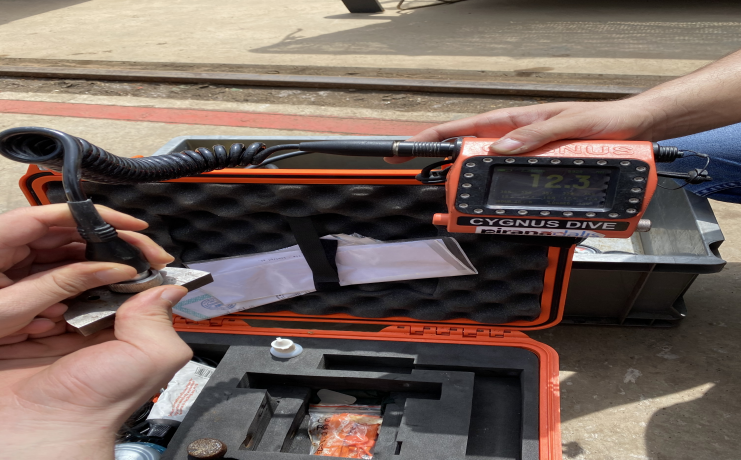
Ultrasonic Thickness Measurement (UT) is a reliable non-destructive testing method used to determine the remaining wall thickness of steel structures, plates and pipelines.
During the measurement process, ultrasonic sound waves are transmitted into the material. The time required for the signal to travel through the material and return is analysed to determine the remaining metal thickness.
Benefits of Ultrasonic Thickness Measurement
Periodic thickness measurements allow changes in metal loss to be monitored over time and support maintenance decisions with actual measured data.
Underwater ACFM Crack Inspection
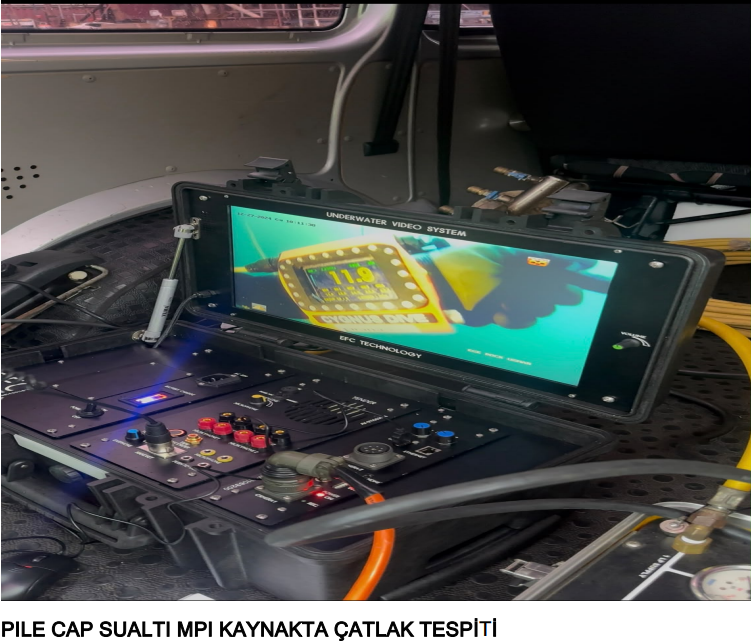
ACFM (Alternating Current Field Measurement) is an advanced non-destructive testing technique used for detecting surface-breaking cracks in metallic structures, particularly around welded connections.
The technique analyses changes in an electromagnetic field generated using alternating current. This allows discontinuities in welds and parent material to be detected and assessed.
Underwater ACFM can be applied to offshore platforms, vessel hulls, jetty connections, weld seams and other subsea steel structures.
ACFM and MPI Inspection Methods
Alternating Current Field Measurement
ACFM may be used to detect and characterise surface-breaking cracks, particularly in welded areas of offshore and marine structures.
- Can be applied over certain painted or coated surfaces.
- Suitable for inspection of welded areas.
- Can provide information about crack dimensions.
- Suitable systems can be used in underwater environments.
- Generally requires less surface preparation than some other methods.
Magnetic Particle Inspection
MPI (Magnetic Particle Inspection) is a non-destructive testing method used to identify surface and near-surface discontinuities in ferromagnetic materials.
- Crack inspection of welded joints
- Inspection of steel platform connections
- Inspection of chains and steel components
- Rapid detection of surface-breaking cracks
- Support for maintenance and weld quality assessment
Underwater MPI for Weld Crack Detection
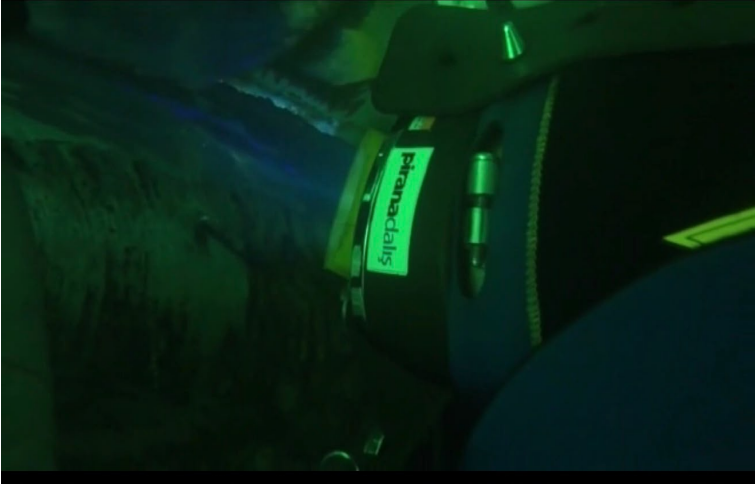
In Magnetic Particle Inspection, the ferromagnetic component is magnetised and suitable magnetic particles are applied to the inspection surface. Magnetic flux leakage at a discontinuity causes the particles to accumulate around the defect, making it visible for evaluation.
Underwater MPI can be used on pile cap connections, weld seams, vessel structures, offshore platform components, chains and steel connections in jetty structures.
Findings may be supported by underwater video and photographic records, providing field data for maintenance planning and further engineering assessment.
Where Is Underwater NDT Used?
Professional underwater NDT and thickness measurement services are used for periodic inspection, integrity assessment and maintenance planning of critical marine structures across a wide range of industries.
Ports and Jetty Structures
- Jetty and marine pile inspections
- Underwater weld inspections
- Pile thickness measurement
- Structural condition assessment
Offshore Facilities
- Jacket platforms
- Subsea manifolds
- Subsea pipelines
- Structural connections
Shipyards and Vessels
- Vessel hull inspections
- Underwater hull thickness measurement
- Weld quality inspections
- Propeller and rudder areas
Power and Industrial Facilities
- Seawater intake systems
- Cooling water pipelines
- Marine outfall pipelines
- Steel structures
Our Professional Underwater NDT and Inspection Services
Pirana Diving performs underwater inspection and NDT services for vessels, ports, offshore structures and industrial facilities using experienced commercial diving teams and specialised technical equipment.
Why Should Underwater NDT Be Performed Regularly?
Salinity, currents, marine growth, mechanical loading and corrosion can cause gradual material loss and structural deterioration in steel structures exposed to marine environments.
Regular underwater inspections help monitor these changes and allow maintenance requirements to be identified before they develop into more serious structural problems.
Do you require underwater thickness measurement or NDT inspection?
Contact Pirana Diving for ultrasonic thickness measurement, ACFM, MPI, subsea pipeline inspection, vessel hull inspection, offshore NDT, ROV-assisted inspection and technical surveys of port and marine structures.